Tag: Academic Research

  • Production Quality and Professional Commitment Crucial for Book Sales Performance, Dr. Obiyinka’s PhD Research Reveals

    Production Quality and Professional Commitment Crucial for Book Sales Performance, Dr. Obiyinka’s PhD Research Reveals

    Chief Sunday Omoniyi Obiyinka, Ph.D., mni, Defends Pioneering Thesis on Book Sales performance  in Southwestern Nigeria

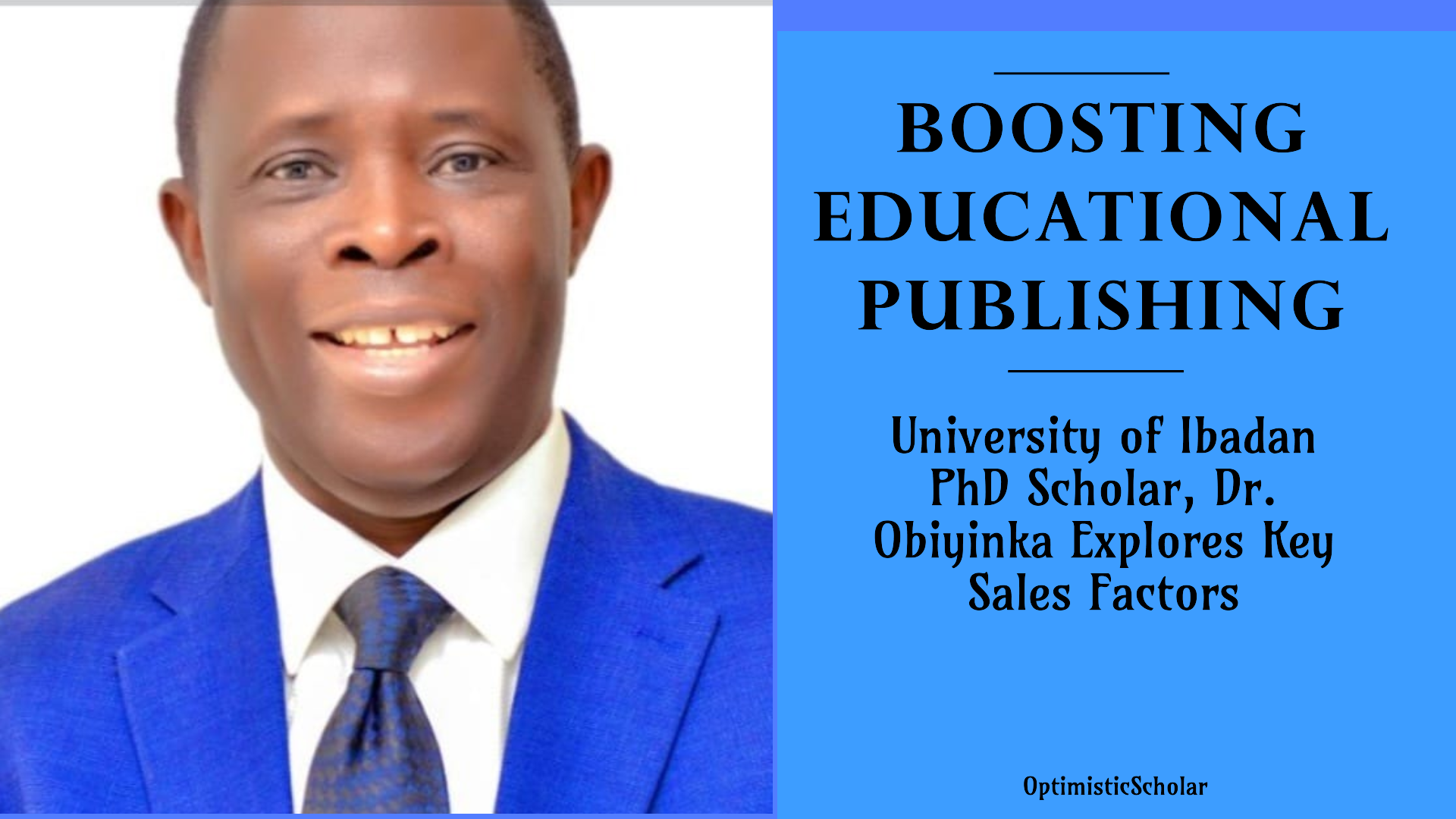
    Chief Sunday Omoniyi OBIYINKA, Ph.D., mni, Chief Executive Officer of Extension Publications Limited and a prominent member of the Nigerian Publishers Association, has made history as the first individual to earn a Ph.D. in Publishing and Copyright from the University of Ibadan, Nigeria.  He becomes only the second person in Nigeria to achieve this distinction, following Professor O.A. Okwilagwe, who earned his Ph.D. in Publishing from Stirling University, Scotland, over two decades ago.

    Dr. Obiyinka’s recently defended doctoral thesis, titled *Production Quality, Professional Commitment, and Marketing Strategies as Determinants of Book Sales Performance of Educational Publishers in Southwestern Nigeria, was completed under the Department of Library, Archival, and Information Studies, specifically within the Publishing and Copyright Unit. Supervised by Associate Professor, Dr. Clement Adeniyi Akangbe, his research offers fresh insights into the factors that influence book sales performance among educational publishers in southwest Nigeria

    The thesis highlights the critical role of production quality—content and form—and the professional commitment of sales representatives in driving book sales. Contrary to traditional views, the study found that marketing strategies had a lesser impact on sales performance.

    Key Takeaways from the Study:

    • Strong Sales Despite Challenges: Educational publishers in Southwestern Nigeria maintained high sales performance due to the exceptional quality of their books.
    • Professional Commitment Gaps: Sales representatives showed emotional attachment to their roles but lacked a deep organizational commitment, which may pose long-term challenges for workforce stability.
    • Adoption of Technology: Publishers have effectively utilized technology to reduce costs and improve customer satisfaction, ensuring competitiveness in the market.
    • Production Quality and Commitment as Sales Drivers: Production quality and professional dedication were found to be the main drivers of sales, while marketing strategies had a more limited impact.

    Recommendations for the Industry:
    Dr. Obiyinka advises that publishers strengthen logistical and promotional support for their sales teams, enforce rigorous quality control at all production stages, and enhance staff welfare to boost professional commitment. He also encourages greater adoption of modern technology to complement traditional marketing methods.

    A Landmark Contribution to the Field:
    Dr. Obiyinka’s research underscores the critical importance of production quality and staff commitment in achieving sales success, while downplaying the role of marketing strategies alone. His findings offer a practical framework for educational publishers seeking to improve internal processes and enhance sales performance.

    As the CEO of Extension Publications Limited and a leader in the Nigerian publishing industry, Dr. Obiyinka’s work represents a significant contribution not only to academia but also to the publishing industry. His status as the first University of Ibadan Ph.D. graduate in Publishing and Copyright adds to the significance of this research, which promises to influence the future of educational publishing in Nigeria. Keep an eye out for further discussions and publications stemming from this landmark work.

    OptimistScholar congratulates Chief Sunday Omoniyi OBIYINKA, Ph.D., mni, on this remarkable achievement and wishes him continued success in his academic journey.

    ________
    Take your research global! For dissemination, academic success stories, conference publicity, and international recognition, connect with OptimistScholar via WhatsApp.

  • An Intellectual Exploration of Impostor Syndrome at the Digital Society School

    An Intellectual Exploration of Impostor Syndrome at the Digital Society School

    Unveiling Shadows: An Intellectual Exploration of Impostor Syndrome at the Digital Society School

    The Digital Society School of the Amsterdam University of Applied Sciences recently hosted a revealing exploration into Impostor Syndrome, a psychological pattern where individuals doubt their accomplishments and fear being exposed as a fraud despite evidence of their competence. Often hidden behind a mask of success, those affected believe they are not as capable as others perceive, attributing their achievements to luck rather than skill. This phenomenon, although not classified as a psychiatric disorder, is rarely the subject of empirical studies, making it a compelling topic for academic inquiry.

    Originally identified by psychologists Clance and Imes in 1978, Impostor Syndrome has been acknowledged by many notable figures including Albert Einstein and Maya Angelou, who despite their substantial contributions, felt undeserving of their accolades. In 2017, psychologist Pauline Rose Clance developed an “impostor scale” to quantify these experiences, which highlights the ongoing relevance and complexity of this issue.

    During our sessions, participants discussed various root causes of Impostor Syndrome, tracing its origins to diverse factors such as background, race, previous experiences, and self-perception. This syndrome not only manifests in academic settings but also pervades professional environments, where achievements are often overshadowed by deep-seated self-doubt.

    In light of these discussions, we are motivated to explore interventions such as bibliotherapy and cinematherapy. These approaches utilize literature and cinema, respectively, to address and alleviate the psychological burdens associated with Impostor Syndrome. Such strategies could offer therapeutic insights and relief to those struggling with these hidden fears.

    Discussion Points:

    1. The Role of Background and Identity: How do personal histories and societal factors contribute to the prevalence of Impostor Syndrome?
    2. Mitigation through Media: Can bibliotherapy and cinematherapy offer effective tools for combating feelings of fraudulence? What other methods might be similarly beneficial?

    3. Recognition vs. Reality: How does recognizing one’s achievements impact one’s perception of impostorism? Can greater external affirmation resolve the internal conflict?

    This initiative seeks not only to understand the deeper implications of Impostor Syndrome but also to develop effective strategies for overcoming it. By fostering an open dialogue, we aim to deconstruct the barriers that prevent individuals from fully recognizing and embracing their success. Your insights and experiences are valuable to this discussion—please share your thoughts and join us in this intellectual exploration.

    Contributed by
    Dr. Sola Owolabi
    The Digital Society School of the Amsterdam University of Applied Sciences