Tag: Project Management

  • Look for Problems, Look for Gaps: The Path from Training to Transformation

    Look for Problems, Look for Gaps: The Path from Training to Transformation

    Building Careers in a Changing World

    By Dr. Ayodele John Alonge | October 1, 2025

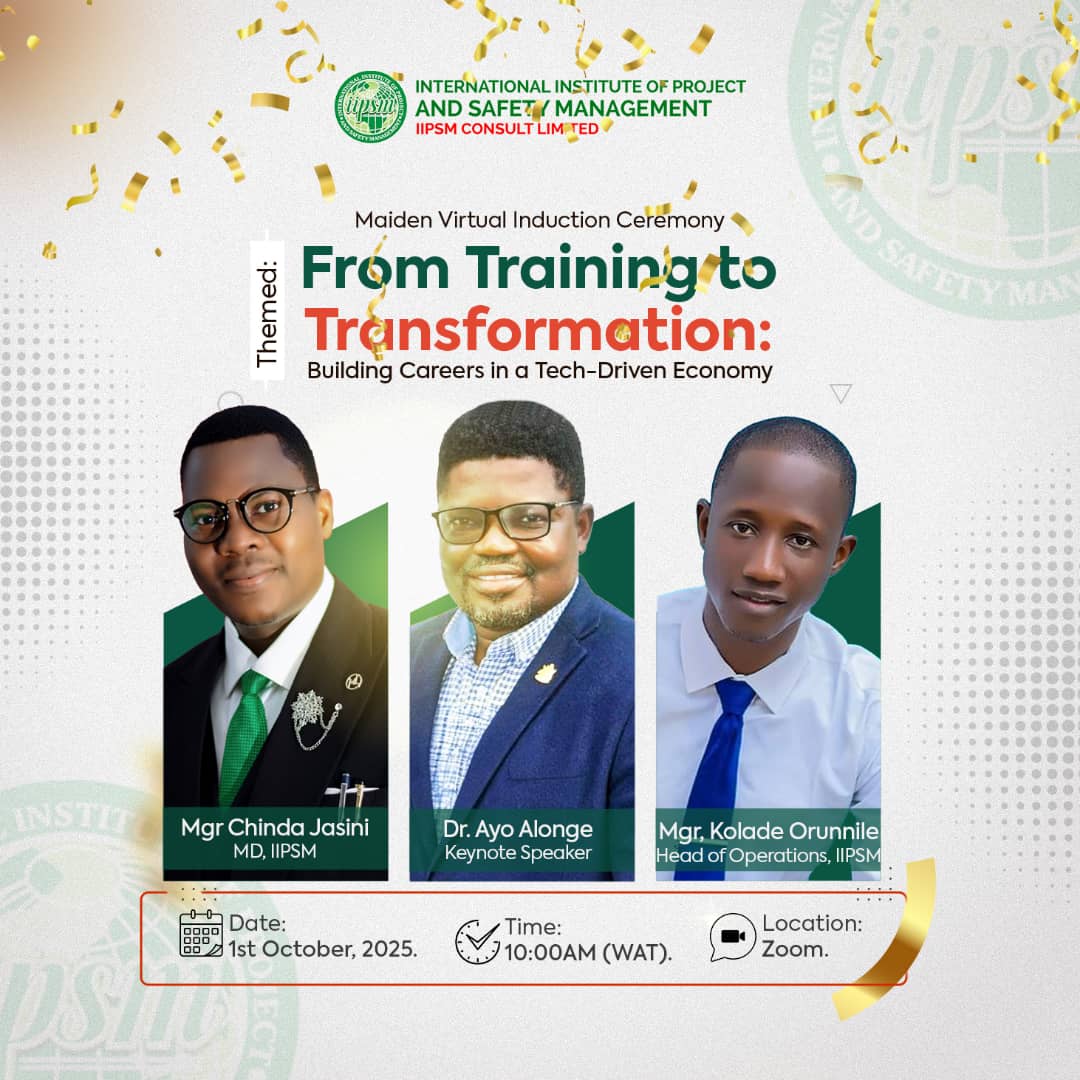
    On October 1st, 2025, a day that also marked Nigeria’s 65th Independence Anniversary, I had the privilege of serving as the Keynote Speaker at the Induction Ceremony of the International Institute of Project and Safety Management (IIPSM).

    The event was a celebration of growth, resilience, and purpose. It was also the first virtual induction ceremony of the Institute, and the Zoom platform was filled to capacity with young professionals, faculty members, and guests from across Nigeria. I joined the session from the United States, where I am currently pursuing another learning experience. It was a moment of reflection, pride, and gratitude as I shared insights on the theme, “From Training to Transformation: Building Careers in a Tech-Driven Economy.”


    Training Is Only the Beginning

    Every phase of life is a project — from education to career, marriage, and personal development. That was the central message of my keynote. I explained that project management is not just a discipline but a life philosophy — a structured, intentional way of setting goals, making plans, and achieving meaningful results.  Reflecting on my journey from a classroom teacher to l being a librarian to becoming university lecturer to a researcher and facilitator beyond africa  I emphasized that professional growth truly begins where training ends. As I said during the ceremony, “Training is the beginning; transformation is the destination.”


    The Power of Lifelong Learning

    When I completed my PhD, I thought since  I had reached the peak of my academic pursuit, I wont need to enroll for formal study any longer. But life soon reminded me that learning never truly ends. Years later, I enrolled in a project management program that completely reshaped my mindset, expanded my network, and opened new doors of opportunity. That experience taught me that lifelong learning is not about collecting certificates — it’s about expanding your capacity to think, staying curious, and building the resilience to adapt in a fast-changing world.  Those who continue to learn and evolve will always find relevance and opportunity. Growth requires curiosity, flexibility, and a willingness to keep improving.


    The Role of Technology in Growth

    I reminded the audience that technology has become the foundation of nearly every profession. When I once taught Application of ICT to Library Science at the University of Ibadan, many of the tools we now take for granted were still emerging. Today, technology shapes how we work, communicate, and learn. The world changes faster than any syllabus, and those who fail to adapt risk being left behind. Whether one is a librarian, engineer, or entrepreneur, digital competence has become essential for progress. Yet, technology alone cannot create excellence. The most successful professionals will always be those who blend their knowledge with human-centered qualities — empathy, collaboration, integrity, and creativity.


    Volunteering, Service, and Transformation

    Transformation is not measured by  the volume of what we learn, but by how we use that knowledge to serve others and humanity. I shared how some of my most meaningful opportunities began through volunteering.  From supporting projects with, Afrelib, UK, the Gideons International to leading youth and community initiatives in my church in the Netherlands and the United States, These volunteers services  have opens doors that money alone cannot. Sometimes, offering your time, energy, and creativity freely becomes the bridge to a larger purpose. Volunteering helps you see the world differently. It helps you look for problems and look for gaps that others might overlook. These are the starting points for meaningful innovation and transformation.


    From Training To Transformation:  Building a Career with Purpose

    In my message to the new inductees, I encouraged them to think globally but act locally. It is within our local communities that opportunities for real impact often emerge. I reminded them: there may not be jobs everywhere, but there are problems everywhere — and problems are opportunities in disguise. The real professional is not the one who waits for employment but the one who identifies gaps, solves problems, and creates value.  One of my guiding principles has always been: Look for problems, look for gaps, and see how you can fill them. Every solution you design, every innovation you introduce, and every life you touch becomes a testament to transformation through learning.


    Practical Advice for New Inductees

    During the keynote lecture, I shared some practical advice that can guide the new inductees in their journey of professional and personal growth:

    • Master Your Tools: Learn tools like Scrum, Jira, Miro, and Microsoft Teams.

    • Develop a Digital Mindset: Keep learning — sign up for webinars, workshops, and online courses.

    • Tell Your Story: Build your personal brand on news media like  LinkedIn. Share your achievements and reflections — the world needs to hear your story.

    • Think Globally, Act Locally: Seek global best practices, but apply them to solve local problems.

    • Stay Ethical: Integrity and honesty are key to sustained success.

    • See Life as a Project: Set goals, plan milestones, manage risks, and celebrate small wins.

    These principles are not just professional habits — they are life skills. They keep us relevant, grounded, and impactful in every season of life.

    A Call to Lifelong Impact

    As I concluded my keynote, I reminded the inductees that while training equips us with knowledge, transformation gives that knowledge meaning and direction. “The future belongs not to those who are merely trained,” I said, “but to those who transform through what they have learned.”

    Every certificate we earn should lead to positive action. Every skill should find expression in service. And every opportunity should become a platform for impact.

    True transformation goes beyond the workplace. It is about what we make work wherever we find ourselves — at home, in the community, in our profession, or in service to others. When we make it a habit to look for problems, identify gaps, and courageously create solutions, we move from success to significance. In doing so, we don’t just build careers — we build communities, strengthen institutions, uplift nations, and leave a lasting legacy.

    Keep learning. Keep serving. Keep transforming.
    Dr. Ayodele John Alonge


  • Mastering Adaptability and Innovation in a Rapidly Changing Business Landscape

    Mastering Adaptability and Innovation in a Rapidly Changing Business Landscape

    From Theory to Practice: Dr. Kingsley T. Ihejirika’s Strategic Insights on Evolving Business Analysis

    A fascinating interview conducted by Deirdre Caren and shared on LinkedIn features Dr. Kingsley T. Ihejirika, who provides a comprehensive account of his progression from scholarly pursuits to influential positions in the field of business analysis. The conversation, appropriately named “Academic Theory to Business Analysis with Kingsley Ihejirika,” took place on Monday, April 15, 2024, and has served as an inspiration to both professionals and newbies in the business world.

    Dr. Ihejirika began his academic career in Nigeria, earning a degree in Library Science. His academic journey continued to New Zealand, where he studied social media and involvement in library systems. His research looked on how libraries could employ social media to increase user engagement and improve reading, giving Dr. Ihejirika a core skill set that he would later use in his business analysis career.

    Dr. Ihejirika’s transition into business analysis appeared to be a natural step. His interest and drive to interact directly with people and processes prompted him to pursue additional schooling in information systems. This transition was prompted by considerable changes in the university system during his tenure, including severe personnel reductions. These experiences demonstrated the value of adaptation and direct interaction in professional contexts.

    Dr. Ihejirika described his first steps in business analysis at the Ministry of Justice in New Zealand, beginning as a strategic business analyst and progressing to a more project-focused job within the digital team. His current responsibilities include designing critical solutions for project success, which he finds both tough and rewarding.

    Reflecting on the fundamental concepts of business analysis, Dr. Kingsley T. Ihejirika emphasised the critical role that data and information management play in today’s business environment. While the integration of artificial intelligence (AI) and other technical breakthroughs is necessary, he believes they should be used to supplement rather than replace the important human capacity for critical thinking and problem-solving. Dr. Ihejirika emphasised that AI and related technologies are best employed as tools to improve human decision-making processes, ensuring that strategic insights and operational decisions are guided by both data-driven analytics and human intuition.

    Dr. Ihejirika emphasised the dynamic nature of the business analysis, emphasising the need for professionals to constantly learn and adapt to rapid changes and difficulties in the business world. He emphasised the importance of adaptability not only in keeping up with technical changes, but also in understanding the larger business environment in order to properly match tech solutions with business goals. Dr. Ihejirika pushed for a proactive learning mentality that includes formal training, self-study, and hands-on experience to gain a better grasp of both emerging technology and strategic business demands. His thoughts assist professionals in managing the complexity of a data-driven business environment while emphasising creativity and strategic thinking.

    Dr. Ihejirika recommends that anyone joining the profession of business analysis or considering a similar career commit to continual learning and be open to mentorship. He emphasises the necessity of having a diverse and problem-solving mindset, which he believes are essential for not only navigating, but thriving in the field of business analysis.

    Dr. Ihejirika’s path from academic theory to practical commercial application exemplifies the dynamic interaction of education and professional practice, providing useful insights for professionals at all stages of their lives. For further insights and discussions, he welcomes connections and conversations on LinkedIn, where he remains an active and influential figure in the business analysis community.

    To watch the full interview with Dr. Kingsley T. Ihejirika, you can visit the provided LinkedIn link.  Watch the full interview on LinkedIn

    Written by
    Dr. Ayodele John Alonge 
    for Optimistic Scholar