

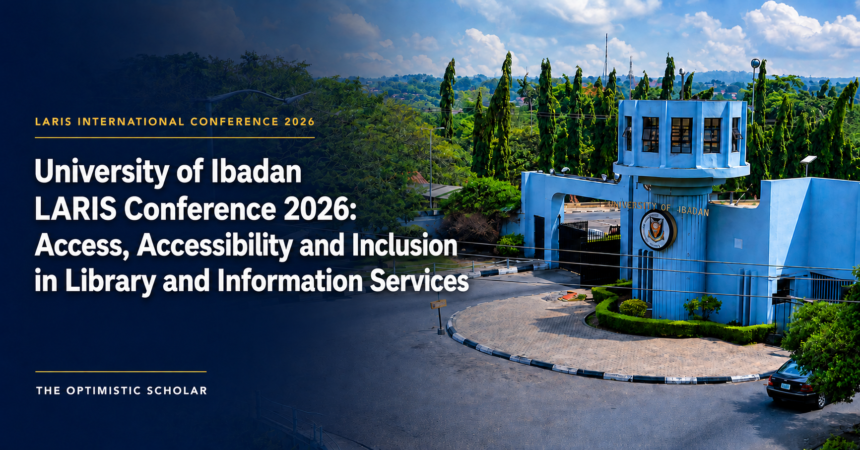
I cannot tell the story of my academic and professional journey without talking about the Department of Library, Archival and Information Studies—LARIS—at the University of Ibadan.
LARIS has been part of my formation for many years. I received my first degree from the department. I returned there for my master’s degree. Later, I had the great privilege of becoming a lecturer in the same department where I had once sat as a student.
That journey—from being taught to having the opportunity to teach others—remains very important to me.
Many of the ideas, values and professional relationships that have shaped my work in librarianship, archives, publishing, communication and information studies can be traced to LARIS. The department gave me a foundation. It challenged me intellectually. It also gave me room to grow as a scholar and professional.
So, whenever something important is happening in LARIS, I do not see it as information coming from a distant place. I receive it personally. It is news from home.
More Read
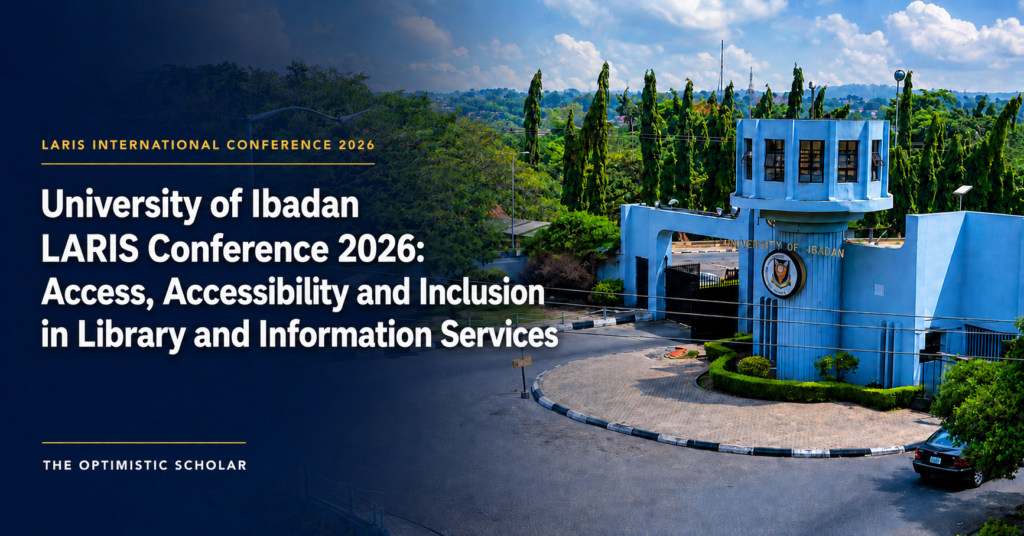
I am therefore glad to share that the Department of Library, Archival and Information Studies, University of Ibadan, is organising the LARIS International Conference 2026.
The conference will take place from August 31 to September 4, 2026, at th
e University of Ibadan, Nigeria.
More Read

A Timely and Important Theme
The theme of the conference is:
Access, Accessibility and Inclusivity in Library and Information Services
This theme speaks directly to the realities of our time.
We often talk about access to information, but access alone is not enough. Information may be available, yet many people may still be unable to use it. A book may be in the library, but can a person with a visual impairment read it? A journal may be online, but can a student who cannot afford the subscription gain access to it? A community may have important Indigenous knowledge, but is that knowledge represented in our libraries, archives and digital systems?
These are not merely academic questions. They are questions about people, opportunity, dignity and justice.
As librarians, archivists, publishers, educators, researchers and information professionals, we must continue to ask ourselves: Who has access? Who is still excluded? Whose knowledge is preserved? Whose voice is missing? Who benefits from the new technologies we celebrate?
More Read

That is why I believe this conference is timely.
The Areas of Conversation
The conference will provide opportunities for scholars and professionals to discuss important issues such as:
- Digital access and inclusive library services
- Information services for persons with disabilities
- Artificial Intelligence and equitable access to information
- Open access and the democratisation of knowledge
- Indigenous knowledge systems and inclusive knowledge representation
- Health information systems and patient-centred information services
- Ethical and legal issues in access to health information
- Copyright and intellectual property in the digital information environment
- Inclusive scholarly publishing and global knowledge equity
- Digital publishing and inclusive readership
- Book production, marketing and accessibility in the age of new technologies
- Community archives and inclusive archival practices
- Digitisation and preservation for improved access
- Indigenous archives and inclusive memory institutions
- Legal frameworks affecting access to archival materials
Looking through these sub-themes, I can see connections with many areas that have shaped my own work and interests: librarianship, archives, digital transformation, publishing, copyright, Artificial Intelligence, health communication and the preservation of memory.
I am particularly interested in the conversations around Artificial Intelligence, equitable access, Indigenous knowledge, health information and inclusive archives. Technology is changing our profession very quickly. However, as we move forward, we must be careful that the people who were excluded in the past are not excluded again in the digital future.
Digital transformation must also be inclusive transformation.
Learning from Distinguished Professionals
The keynote address will be delivered by Professor Lenrie O. Aina, former National Librarian of Nigeria. Professor Aina is a respected scholar whose work has contributed greatly to the development of Library and Information Science in Nigeria and beyond.
The conference will also feature lead paper presentations from:
- Professor Adebambo Oduwole, University Librarian, Tai Solarin Federal University of Education, Ijagun, Ogun State
- Chief Sunday Omoniyi Obiyinka, PhD, mni, Managing Director and Chief Executive Officer, Extension Publications Limited
- Salihu Muhammad-Rabiu, Deputy Director, Medical Records and Health Services, Federal University of Agriculture, Abeokuta
- Dr Kolawole Oseni, Managing Director and Chief Executive Officer, PWK Consultancy Services, and an information management expert
I believe the different experiences of these speakers—from librarianship and publishing to medical records and information management—will make the conference conversations rich and practical.
Physical and Virtual Participation
The opening ceremony will take place at Trenchard Hall, University of Ibadan, while the plenary sessions will be held at the Department of Library, Archival and Information Studies.
One good thing about the conference is that people can participate physically or virtually. This makes it possible for colleagues outside Ibadan, outside Nigeria and in other parts of the world to join the conversation.
The registration fees are:
- Regular participants: ₦40,000 physically or ₦25,000 virtually
- Postgraduate students with identification: ₦25,000 physically or ₦15,000 virtually
- Undergraduate students: contact the organisers for confirmation of physical participation; virtual participation is ₦10,000
- International participants: US$100 physically or US$50 virtually
Registration can be completed through the conference link:
Register for the LARIS International Conference 2026
The earlier call for papers listed the following dates:
- Abstract submission deadline: May 31, 2026
- Notification of abstract acceptance: June 15, 2026
- Full paper submission deadline: June 30, 2026
- Registration deadline: July 30, 2026
Since some of these dates have passed, anyone who is still interested in presenting a paper or registering should contact the organisers to ask whether late submissions or registrations can still be considered.
Why I Am Sharing This
I am sharing this conference because I know what professional gatherings like this can do in the life of a student, young researcher or practising professional.
A conference is not only a place to present a paper. It is a place to listen, ask questions, meet people and encounter ideas that may change the direction of one’s work. Sometimes, one conversation at a conference can lead to a collaboration, publication, mentorship opportunity or completely new way of thinking.
For students and early-career professionals, this is an opportunity to learn from those who have travelled ahead. For experienced professionals, it is also an opportunity to share knowledge, reconnect with colleagues and contribute to the future of the profession.
For me, it is also a moment of gratitude.
I look back and remember myself as a student in LARIS. I remember the classrooms, lecturers, assignments, professional conversations and relationships. I remember returning for my master’s degree. I remember the privilege and responsibility of eventually standing before students as a lecturer in the same department.
Now, from another part of my continuing journey, I am happy to see the department creating a space where scholars and professionals can gather to discuss access, accessibility and inclusivity.
The profession must continue to change, but it must never lose sight of the people it exists to serve.
The library must be open, but people must also be able to enter.
Information must be available, but people must also be able to understand and use it.
Technology must advance, but no one should be left behind.
Archives must preserve memory, but they must also recognise the memories and voices that have too often been ignored.
This is the kind of conversation that the LARIS International Conference 2026 is inviting us to have.
I warmly invite my colleagues, former students, librarians, archivists, publishers, information professionals, health information practitioners, researchers and students to participate.
LARIS has played an important role in my becoming. I am proud to share this important step in the continuing journey of the department.
Conference Information
Conference: LARIS International Conference 2026
Theme: Access, Accessibility and Inclusivity in Library and Information Services
Dates: August 31–September 4, 2026
Venue: University of Ibadan, Ibadan, Nigeria
Participation: Physical and virtual
Registration: https://shorturl.at/maZWx
Email: larisconference@gmail.com
For enquiries:
Professor C. A. Akangbe: +234 803 473 5274
Professor Airen Adetimirin: +234 802 333 6038
I am Dr Ayodele John Alonge—the Optimistic Scholar.