You can also SUBSCRIBE to our Newsletter Here
The 1767 Morgan Psalm Book: More Than an Old Book
It has been a deeply enriching and humbling experience for me to be named one of the 2025–26 Morgan Fellows. This fellowship, which brings together scholars from Candler School of Theology and Columbia Theological Seminary, offers a unique opportunity to engage in original research on items in the Morgan Collection, where collection donor Michael Morgan served for many years as organist. As fellows, we are invited not only to study these rare materials, but also to present our findings publicly and contribute to a digital exhibition on the library’s Digital Collections site.
This year, the Morgan Forum took place on April 2, 2026, at Candler School of Theology, Emory University. It was a meaningful occasion for scholarship, interpretation, and public engagement around rare and significant materials from the collection.
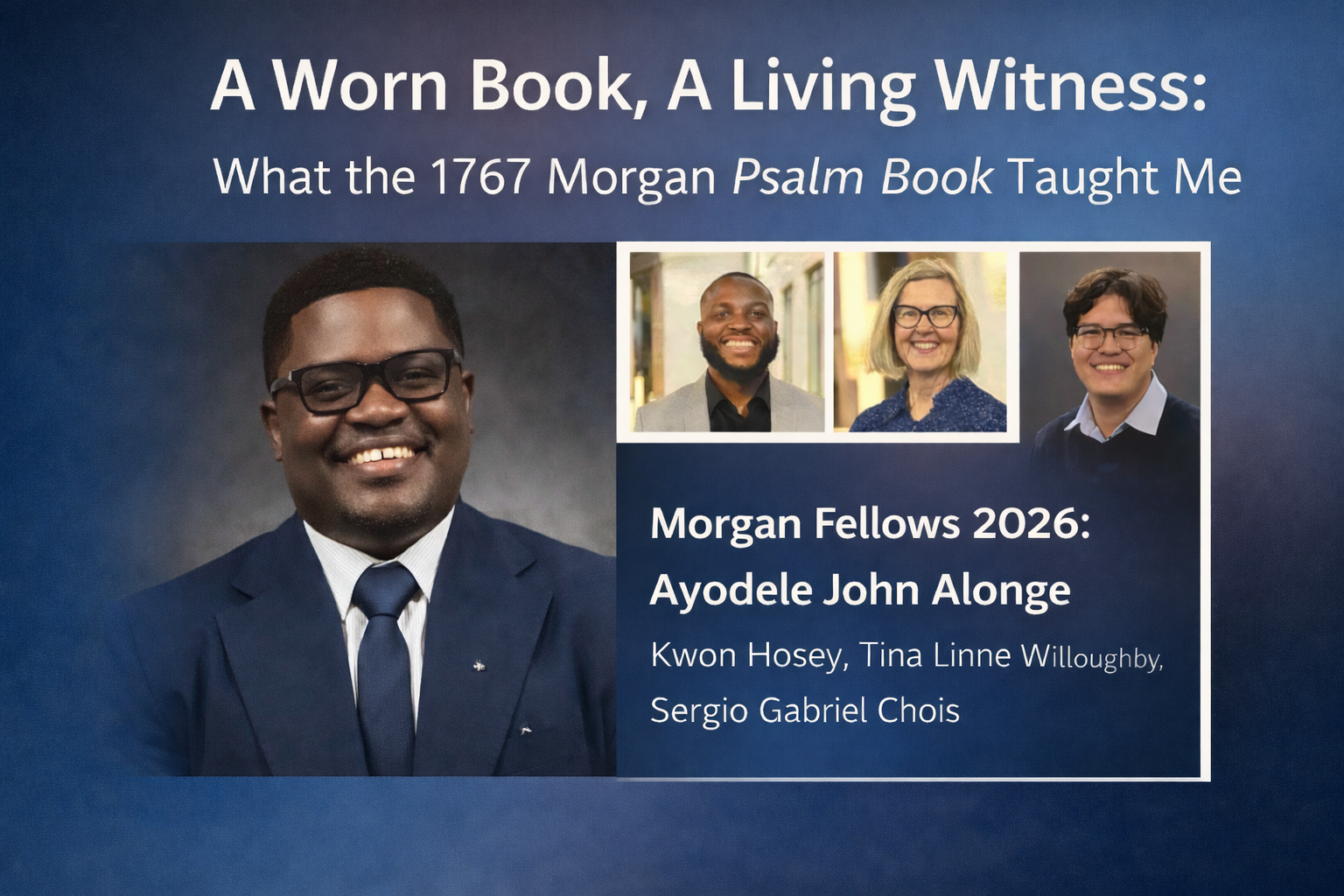
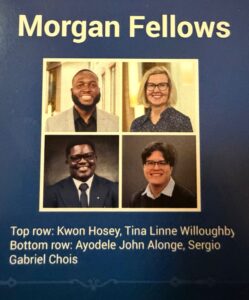
This year’s Morgan Fellows are:
- Ayodele John Alonge, Master in Practical Theology student, Columbia Theological Seminary
- Sergio Gabriel Chois, Master of Theological Studies student, Candler School of Theology
- Kwon Hosey, Master of Divinity student, Columbia Theological Seminary, and a graduate of Candler’s Master of Theological Studies program
- Tina Linne Willoughby, Master of Arts in Religion and Leadership student, Candler School of Theology
For me, being part of this fellowship has been more than an academic exercise. It has been a season of learning, reflection, and deeper appreciation for the ways books carry memory. It has allowed me to encounter a rare volume not merely as an old object preserved in a library, but as a witness to worship, identity, language, devotion, and survival. Among the materials I studied, one book in particular captured my attention: the 1767 Morgan Psalm Book.
Some books speak only through the words printed on their pages. Others speak through much more: through their age, their condition, their handwritten marks, and the traces left by the people who used them. For me, the 1767 Morgan Psalm Book is one of those books.
At one level, it is a rare religious text. Its full title is The Psalms of David, with the Ten Commandments, Creed, Lord’s Prayer, &c. in metre. Also, the Catechism, Confession of Faith, Liturgy, &c. Translated from the Dutch. For the use of the Reformed Protestant Dutch Church of the City of New-York. Printed in New York in 1767, the volume belongs to an important period in the life of the Reformed Protestant Dutch Church, when worship and religious practice were moving from Dutch into English. That alone makes it historically significant. It stands as evidence of a faith community negotiating language, worship, and identity in a changing world.
Yet what makes this book especially compelling to me is that it is not only a text to be read. It is a material witness. It tells a story through its very form.
Psalm books such as this were central in their original setting. They were not decorative objects placed on shelves simply for admiration. They were books for use: for singing, worship, teaching, devotion, and spiritual formation. In the Reformed tradition, the Psalms were deeply woven into congregational life. They were sung together, memorized, and used as part of the rhythm of faith. This particular volume brings together psalms, doctrinal materials, catechism, confession, prayer, and liturgy in one book. It was therefore more than a songbook. It was also a tool of formation and a portable expression of communal identity.
The translation dimension of the volume is equally significant. This was a church community rooted in Dutch Reformed tradition but increasingly functioning in English. The shift represented in this book was not simply a matter of vocabulary. It was part of the larger work of carrying faith, theology, and worship across a linguistic and cultural transition. In that sense, the book reflects continuity as much as change. It shows how communities preserve inherited traditions even as they adapt to new realities.
What stayed with me most, however, was the physical condition of the Morgan copy itself.
The copy I examined measures approximately 7.7 by 5 inches and is about 2 inches thick. It has a thick, old binding and bears visible signs of age, wear, and long survival. Its spine and back appear darkened, almost burnt in places. The entire object gives the impression of having endured much over time. It does not look like a book that was preserved from the beginning under ideal archival conditions. Rather, it looks like a book that was handled, used, perhaps neglected, and yet somehow survived. That survival is, for me, one of the most striking things about it.
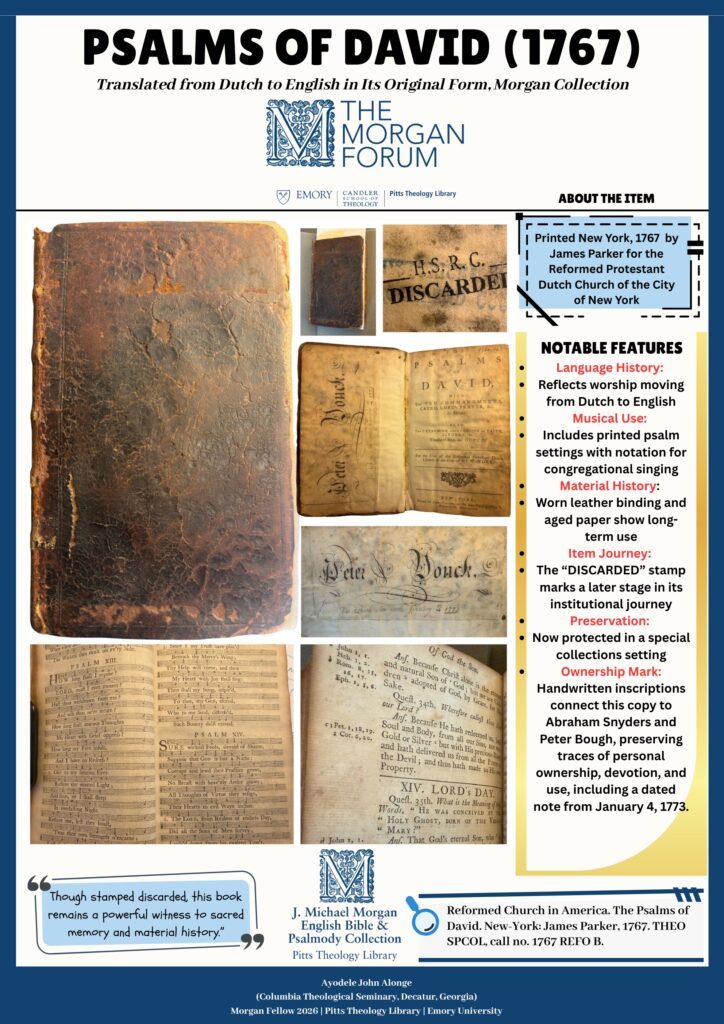
I was able to compare it with other copies of the same work, and some of those appear to have been rebound more neatly. They look cleaner, more polished, and more stabilized. But the Morgan copy seems to preserve more of its older, perhaps original physical state. That matters greatly. A rebound copy may be structurally stronger or visually attractive, but a copy that retains more of its earlier material condition can often tell us more about the actual life of the object. It preserves evidence not only of printing and binding, but also of use, handling, storage, damage, and endurance.
For that reason, I do not see the wear on this book simply as damage. I see it as testimony.
The human story of the volume becomes even richer through its handwritten inscriptions. Among the names written in the book are Abraham Snyders and Peter Bough. Alongside these names are phrases such as “God give him grace therein,” “Fear God and Honour the King,” and “learning is better than house [or] land.” There is also a dated inscription connected to Peter Bough: “January ye 4th 1773.”
These inscriptions are deeply meaningful. They show that this was not simply a printed object circulating anonymously in the world. It was personally owned, marked, and valued. These handwritten words suggest devotion, moral reflection, and perhaps even educational or household use. They show that the book lived beyond the printing press and beyond the title page. It entered homes, hands, and hearts.
I find that profoundly moving.
To encounter a phrase such as “learning is better than house [or] land” in a book like this is to see more than a declaration of ownership. It is to glimpse a way of valuing the world. It suggests that the owner saw learning, wisdom, and formation as riches greater than material possession. Likewise, “God give him grace therein” reflects a devotional posture, not just a casual note. These inscriptions transform the book from an artifact into a lived object. They make visible the spiritual and intellectual lives of those who once held it.
At the same time, much about the book’s journey remains unknown. We can see traces of ownership, but we do not yet know the full story of how it passed from one person to another or how it eventually entered institutional custody. There also appears to be evidence that at some point it may have been treated as no longer valuable, though such conclusions must be made carefully where documentary evidence is incomplete. What is clear, however, is that the book later found preservation in the Morgan collection, where it now stands not only as a rare printed work but also as an object of religious and cultural memory.
This raises an important question: what do we preserve, and why?
Too often, preservation is imagined as the saving of perfect things: clean copies, elegant bindings, visually beautiful objects. But many of the most meaningful materials in archives are those that bear the scars of use and survival. They reveal the tension between value and neglect, between preservation and loss, between being cherished and nearly forgotten. The Morgan Psalm Book invites us to think more deeply about preservation. It reminds us that what appears worn or damaged may in fact hold some of the richest evidence of human history.
It also invites reflection on the tension between conservation and access. A cleaned, repaired, or rebound copy may be easier to handle and use. Yet some of the traces that make a book historically powerful may also be reduced in the process. The Morgan copy challenges us to think carefully about how to preserve not only text, but also material memory.
For me, this book still speaks across time. It speaks about worship. It speaks about language and identity. It speaks about ownership and devotion. It speaks about what people chose to write in their books and what those choices reveal about their world. It speaks about survival, not in abstract terms, but in the physical reality of an object that appears to have endured much and still remains.
In the end, the 1767 Morgan Psalm Book is more than an old religious volume. It is a witness. It is a witness to psalm singing and Reformed worship. It is a witness to translation and changing religious identity. It is a witness to personal ownership and moral inscription. It is a witness to wear, neglect, and preservation. And it is a witness to the enduring importance of material culture in helping us understand the past.
It also leaves us with questions that deserve further study. Who exactly were Abraham Snyders and Peter Bough? How did this copy move through time from private ownership into a modern collection? What happened to it during the period when it appears to have suffered damage or neglect? And what might comparison with other surviving copies reveal about how this edition was used, preserved, or altered over time?
Dr Ayodele John Alonge is a Morgan Fellow for 2026 and a Master in Practical Theology student at Columbia Theological Seminary.
His work reflects a growing interest in the intersections of faith, archives, memory, books, and public scholarship.
...For the latest news update, Subscribe to our WhatsApp Group Chat (Click Here)
You can also SUBSCRIBE to our Newsletter Here
Have any questions, send us a mail via info@optimisticscholar.com or Click Here
Get real time update about this post category directly on your device, subscribe now.